


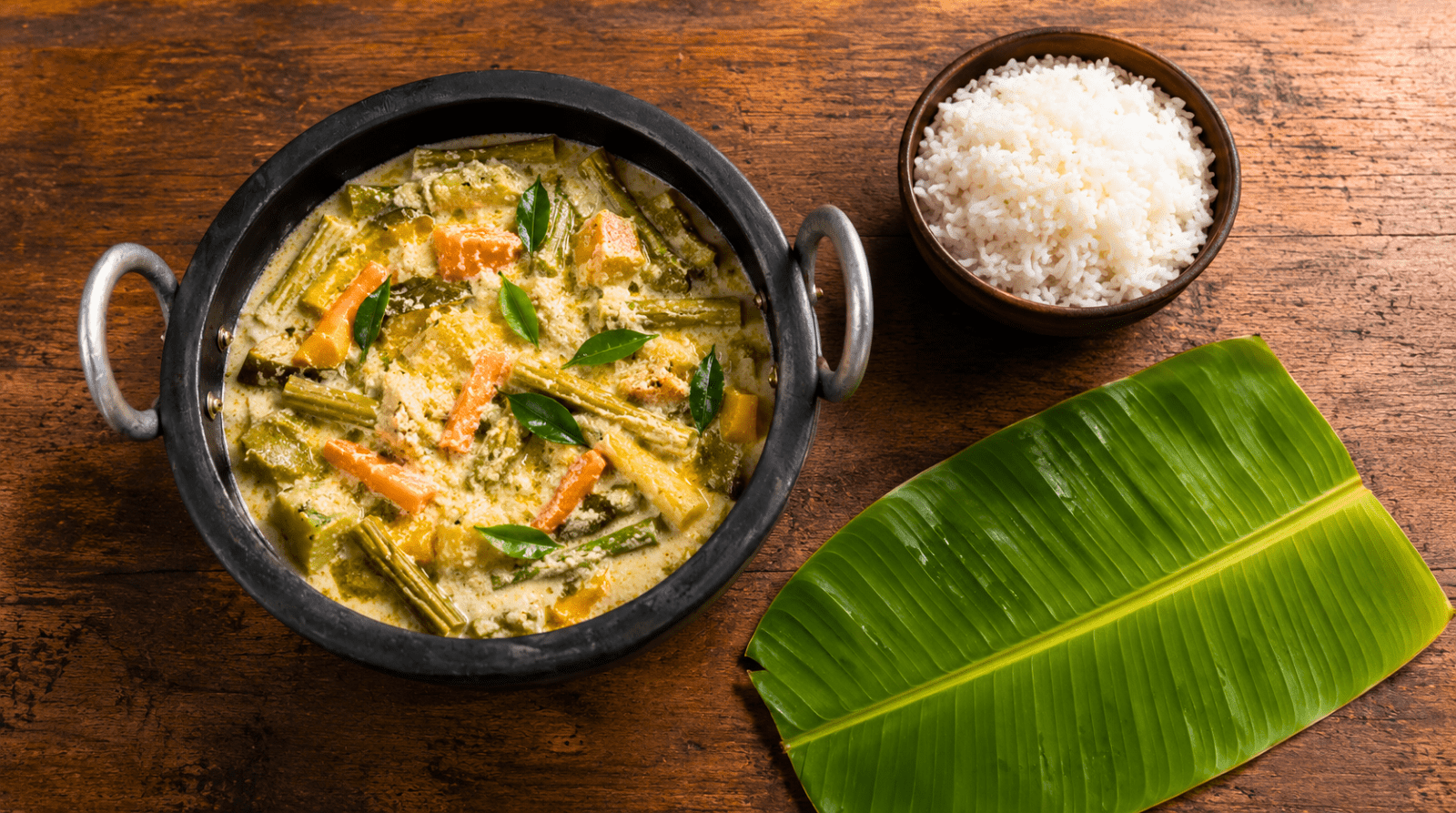
Avial is the dish that defines a Kerala sadya — thirteen vegetables, one pot, no shortcuts. It's not fried, not tempered in the usual sense, just simmered slow until the coconut, curd, and vegetables settle into something greater than the sum of their parts. Every home has an opinion on the right vegetables, the right thickness, the right point to add the curd. There is no wrong avial, only yours.
This is a dish that was always cooked in clay — old Kerala kitchens used a kal chatti, a stone or clay pot, specifically because avial should never be rushed. A Twin Palmyra clay kadai does the same job today: it holds heat evenly and gently, so the vegetables cook through without breaking apart, and the coconut doesn't catch or scorch the way it can in a thin metal pan. Clay finishes what a low flame starts.
Step 1 – Grind the Coconut Masala
In a mixer jar, add ½ teaspoon cumin seeds, 1 cup grated coconut, 5 to 10 shallots, and the green chillies. Grind coarsely with a splash of water — this isn't meant to be a smooth paste.
Avial's character comes from texture, not smoothness. Over-grinding the coconut turns the dish into a paste rather than a curry; stop while the mixture still has bite.

Step 2 – Simmer the Vegetables
In the Twin Palmyra clay kadai, add the chopped elephant foot yam, raw plantain, yellow cucumber, ivy gourd, snake gourd, ash gourd, carrot, long beans, pumpkin, and drumstick, along with 1 teaspoon turmeric powder, 3 teaspoons salt, and 1 cup (250ml) water. Cover and simmer on a low flame.
Keep the flame low and don't stir aggressively — these vegetables cook at different rates, and a hard boil breaks the softer ones before the firmer ones are done. Clay's gentle, even heat is exactly what this step needs.

Step 3 – Fold in the Coconut Masala and Curd
Once the vegetables are just tender, add the ground coconut masala and ½ cup curd. Fold gently with a Twin Palmyra neem wood spatula until combined — do not stir hard.
Curd added too early can split under high heat, and a metal spoon works against the vegetables at this stage. A wooden spatula folds without breaking them, and keeping the flame low from here on keeps the curd smooth.

Step 4 – Finish with Coconut Oil and Curry Leaves
Turn off the heat. Pour 4 tablespoons of coconut oil over the top and scatter in 4 sprigs of curry leaves. Do not stir this in over flame — avial is finished raw, off the heat.
This is the step people get wrong by habit: avial is not tempered in hot oil like most South Indian dishes. The raw coconut oil poured at the very end is what gives it that distinct aroma — cooking it further would burn that off.

Servings: Serves 8–10 people
Twin Palmyra Clay Kadai Cooking Tips
- Season a new clay kadai before first use by simmering water in it for 10 minutes — this closes the pores and prevents cracking
- Always cook on low to medium flame; clay retains heat, so high flame is rarely necessary and can cause thermal shock
- Never place a hot clay kadai directly onto a cold or wet surface — let it cool gradually
- Hand wash only, no soap needed for most residue — clay's natural porosity releases food easily
- Store fully dry, uncovered, to prevent musty odor absorption
- A well-seasoned clay kadai improves with age — the more you cook in it, the better it performs
Avial doesn't ask for much — good vegetables, patience, and the right pot. Cooked slow in clay, the way Kerala kitchens have made it for generations, the vegetables hold their shape and the coconut stays fragrant instead of flat. Serve it with steaming rice, a spoon of ghee, and let the kadai do what it's always done.