


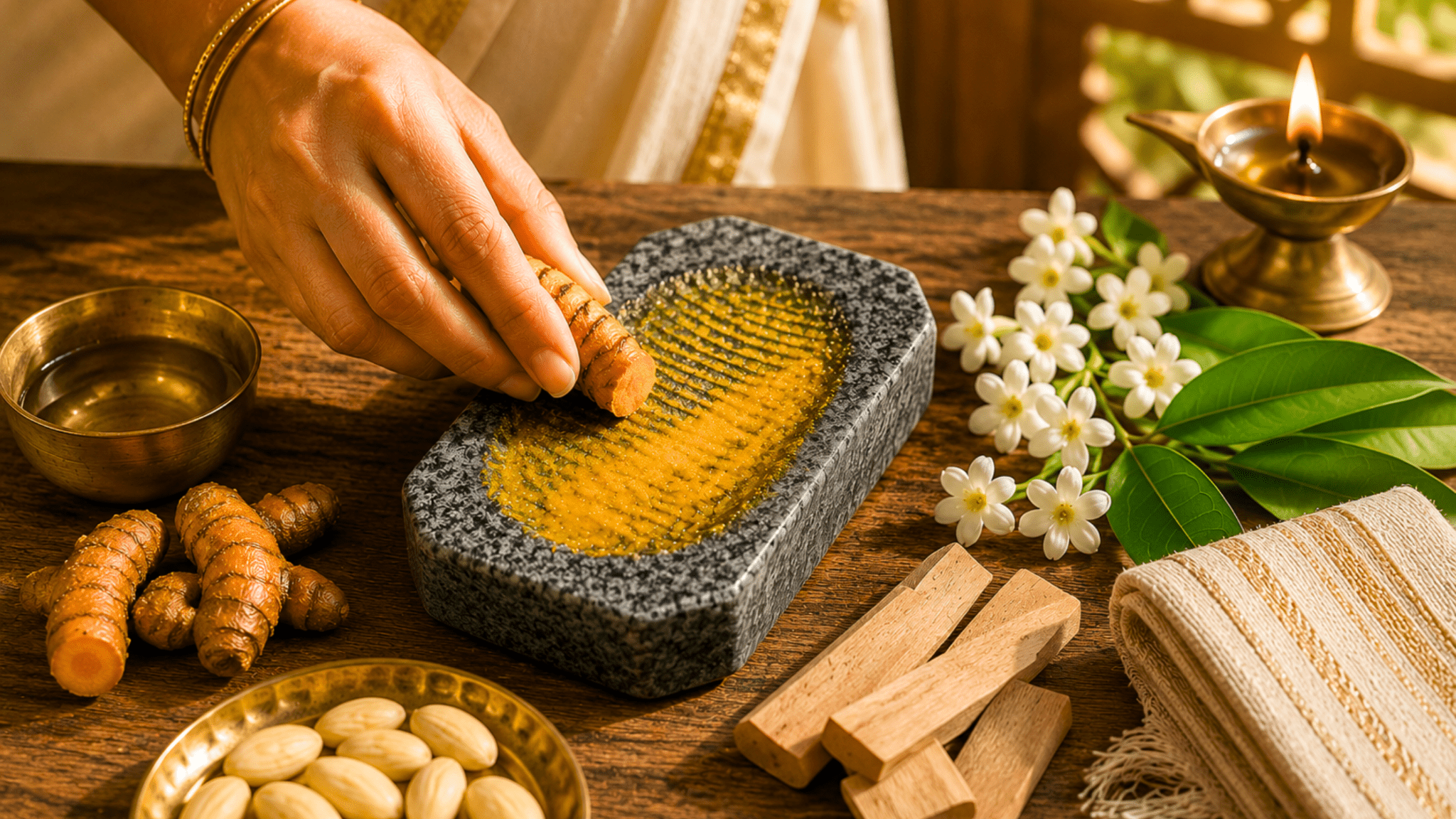
Before turmeric became a wellness trend, before golden milk and glow serums, Indian homes had something far simpler — and far more effective. A flat piece of granite. A little water. And knowledge passed down through generations.
That flat stone is called a Manjal Kal (மஞ்சள் கல்) — literally, "turmeric stone" in Tamil. It is a rubbing stone: a traditional grinding tool used to produce fresh, potent paste from raw turmeric, sandalwood, and almonds. If you've seen one in your grandmother's kitchen and wondered what it actually is and how to use it properly, this guide is for you.
What Is a Rubbing Stone?
A rubbing stone is a flat granite slab used for grinding ingredients by rubbing them against the rough surface with a little water. It is not a mortar and pestle — you do not pound on it. You grind on it, using slow circular motion and pressure.
The flat surface creates friction that breaks down the ingredient at a cellular level, releasing natural oils and active compounds without generating the heat that an electric blender would. That difference matters: heat damages the volatile compounds in turmeric and sandalwood. Stone grinding preserves them.
Pronunciation guide
- Manjal — MUN-jal (the 'a' is short; not "man" as in English)
- Kal — KAAL (rhymes with "call")
What Can You Grind on a Rubbing Stone?
Three ingredients are traditionally ground on a Manjal Kal:
1. Raw Turmeric (Manjal)
Fresh turmeric rhizomes — not powder — are ground into a thick, deeply golden paste. This paste is used as a face and body pack, antiseptic, and brightening treatment. Fresh-ground turmeric retains its natural oils and curcumin in a form that is immediately bioavailable in ways that dried powder cannot match.
2. Sandalwood (Chandanam)
A sandalwood stick is ground on the stone with rose water or plain water. The resulting paste is used to cool the skin, treat blemishes, and as a daily skincare ritual. The fragrance of freshly ground sandalwood is unlike anything in a bottle — it is cooler, deeper, and more medicinal.
3. Soaked Almonds
Almonds soaked overnight in water can be ground into a thick, creamy paste on the rubbing stone. Used as a nourishing face mask or hair treatment. The stone produces a finer, smoother paste than any blender because the grinding surface doesn't heat the almond oils.
How to Use a Rubbing Stone — Step by Step
What you need
- Twin Palmyra Rubbing Stone (Manjal Kal)
- Raw turmeric, sandalwood stick, or soaked almonds
- Small clay pot or bowl of plain water or rose water
- A few minutes of patience
Step 1 — Add water to the stone
Place a few drops of water — 3 to 4 drops — onto the flat grinding surface. You want just enough to create moisture, not a puddle. Rose water can be used instead of plain water for sandalwood grinding; it enhances the fragrance and adds its own skin benefits.
Step 2 — Place your ingredient
Set the raw turmeric or sandalwood stick flat-side down on the stone. For almonds, place 3 to 4 soaked, peeled almonds on the wet surface.
Step 3 — Grind in slow circles
Using gentle but firm pressure, grind the ingredient in slow, circular motions. Let the stone do the work — do not rush. You will begin to see paste forming at the edges within 30 to 60 seconds for turmeric. Sandalwood takes longer: 2 to 3 minutes of consistent grinding.
Add another drop of water if the surface begins to dry out and the paste becomes too thick to move.
Step 4 — Collect the paste
As the paste forms, it will accumulate at the edges of the grinding area. You can collect it with your fingers directly from the stone. For turmeric, a small quantity — roughly the size of a five-rupee coin — is enough for a face application.
Step 5 — Apply and use immediately
Fresh-ground paste should be used within minutes of grinding. It has not been preserved, processed, or diluted. This is its greatest strength — and why it is meaningfully different from anything sold in a tube or bottle.
How to Clean Your Rubbing Stone
Cleaning is simple — and the most important rule is easy to remember:
Never use soap.
Soap will strip the natural oils that the stone absorbs over time, and will leave a residue that contaminates your next grinding session. Rinse the stone with plain water immediately after use. Use a natural bristle brush or your fingers to scrub the surface clean. Let it air dry in sunlight when possible.
That's all. No detergent, no scrubbing pad, no dishwasher.
How Your Rubbing Stone Gets Better Over Time
A rubbing stone is not a tool that degrades with use — it improves. The granite surface seasons gradually as it absorbs the oils from turmeric, sandalwood, and almonds. An older, well-used stone produces paste faster, with less water, and with a slightly smoother consistency than a new one.
This is also why you should grind on it regularly rather than leaving it unused. A stone that is used daily for a month will outperform the same stone used once a week for a year.
Common Questions
Can I use powdered turmeric instead of raw?
You can, but you will lose much of the benefit. The rubbing stone is designed to extract oils from raw ingredients. Powder has already had its volatile oils reduced through drying and processing. Use raw turmeric rhizomes for best results — they are available at most Indian vegetable markets year-round.
How much water should I use?
Start with 3 to 4 drops. The goal is a paste, not a liquid. If you add too much water and the paste runs, let it dry slightly on the stone and continue grinding. Less is more.
Why is my paste not forming quickly?
New stones sometimes need a few uses before their surface opens up. If your stone is new, grind a piece of raw turmeric for 5 minutes (discarding that first batch) to season the surface. From the second use onward, you will notice a significant difference.
Can I grind spices for cooking on the rubbing stone?
The Manjal Kal is traditionally used for cosmetic and medicinal grinding, not cooking. For cooking spices, you want the Kalvam mortar and pestle, which is designed for larger quantities and more aggressive grinding. Keep your rubbing stone for face and body preparations.
Shop the Twin Palmyra Rubbing Stone
The Twin Palmyra Rubbing Stone is sourced from natural granite and sized for daily use. It ships across India and to the United States.
Twin Palmyra. Nature & Necessity.