


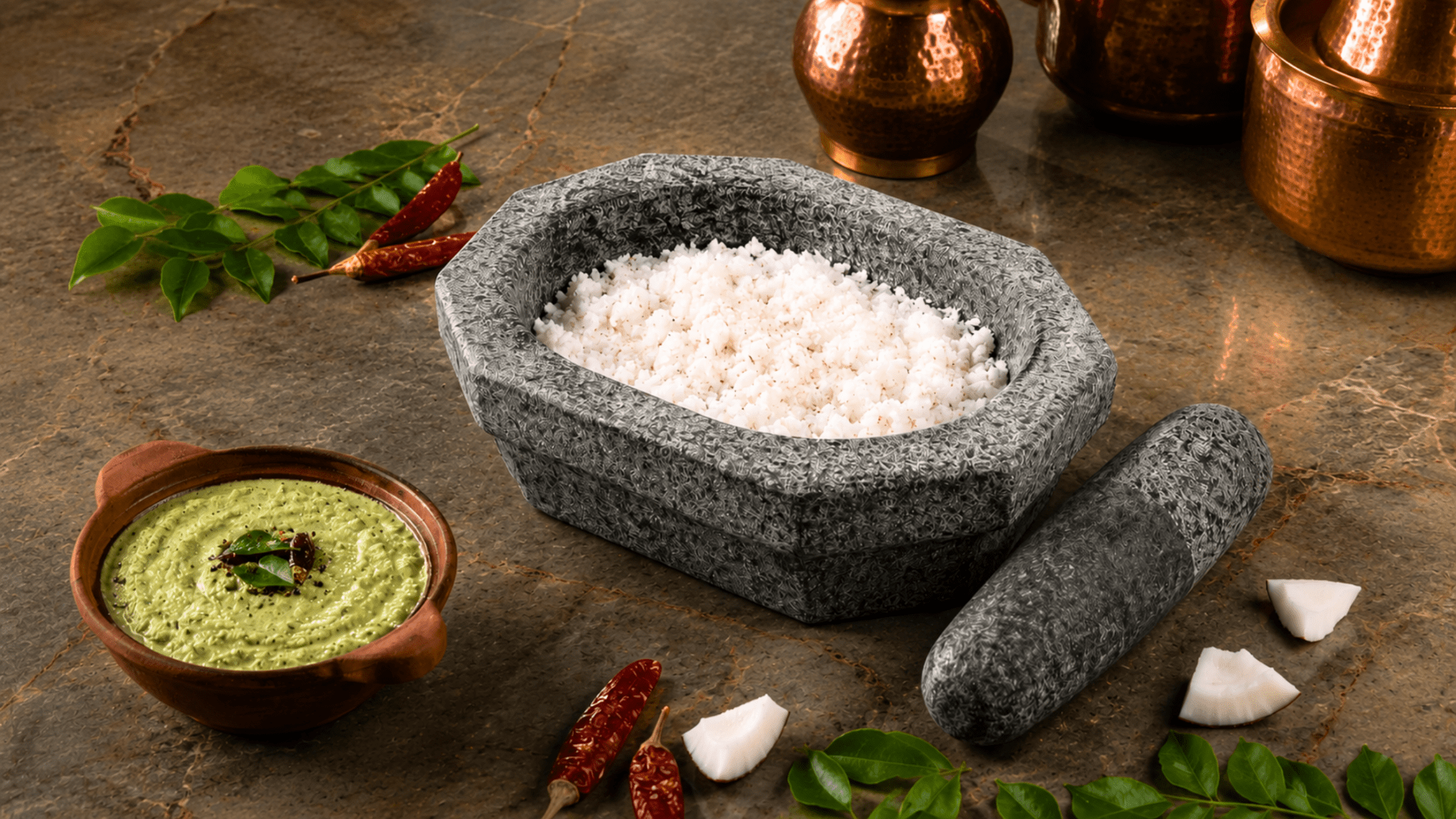
If you've watched your grandmother prepare a fresh coconut chutney or grind ginger-garlic paste the old way, you've seen a Kalvam in action. It's the large, flat stone grinding platform that has been at the heart of South Indian cooking for thousands of years.
In this article, we explain exactly what a Kalvam is, the different types, how they work, and why many cooks — including professional chefs — still prefer them today.
What is a Kalvam?
A Kalvam (கல்வம் in Tamil, also called Aatukal or Ammikal in different regions) is a traditional stone grinding tool used in South Indian kitchens. It consists of two parts:
● A flat or slightly concave base stone (the Kalvam)
● A cylindrical or oval upper stone (the pestle) used to crush and grind by pressing and rolling
It is used primarily in Tamil Nadu, Kerala, Karnataka, and Andhra Pradesh kitchens to grind wet ingredients — coconut, ginger, garlic, spices, and soaked lentils — into smooth, aromatic pastes.
Kalvam vs Mortar and Pestle — What's the Difference?
While both are stone grinding tools, they work differently:
|
|
Kalvam |
Mortar & Pestle |
|
Shape |
Flat base with rolling stone |
Bowl with pounding stone |
|
Motion |
Rolling / pressing |
Pounding / crushing |
|
Best for |
Coconut paste, idli batter, wet masala |
Dry spices, fresh herbs, chutney |
|
Capacity |
Large — family-sized batches |
Small — 1–2 servings |
|
Origin |
South India (Tamil, Kerala) |
Pan-Indian, global |
Types of Kalvam
Traditional Flat Kalvam
The classic large flat stone, typically 18–24 inches long. Used for grinding idli/dosa batter, coconut paste, and wet masalas. Found in traditional Tamil and Kerala households.
Boat Shape Kalvam

A concave, boat-shaped stone that holds ingredients during grinding. Excellent for small quantities like fresh chutneys, herb pastes, and spice mixes. The curved walls prevent ingredients from spilling.
Compact Round Kalvam (5–10 inch)

A smaller, round version ideal for grinding herbs, sandalwood paste, and medicinal preparations. Perfect for modern kitchens where space is limited. Available in 5-inch, 8-inch, and 10-inch sizes.
Why Did South Indian Kitchens Have a Kalvam?

Before electric mixers arrived in Indian homes in the 1970s and 1980s, the Kalvam was the only way to grind wet ingredients to a fine paste. Skilled home cooks could produce silky-smooth idli batter and perfectly textured chutneys using nothing but stone and water.
The Kalvam was so central to South Indian cooking that in traditional homes, it was gifted to a new bride as part of her wedding trousseau — alongside a brass vessel and a clay pot.
Is a Kalvam Better Than a Mixer Grinder?
For certain tasks, yes. Here's what stone grinding does that a mixer cannot:
● Preserves the natural oils and aromas in fresh spices and herbs — heat from mixer blades destroys some of these
● Produces a smoother, denser paste — stone grinding creates a different texture than blending
● No electricity needed — fully portable and hands-on
● Zero plastic or metal contamination — pure stone-to-food contact only
Most modern cooks use a mixer grinder for speed and a Kalvam for small, fresh preparations where texture and aroma matter — like fresh ginger paste for chai or coconut chutney for idli.
How to Buy a Kalvam
When choosing a Kalvam, look for:

● Natural granite or basalt stone — denser stone grinds better and lasts longer
● Hand-chiselled surface — slight roughness aids grinding
● Weight — heavier stones stay stable during use
● Size — a compact 8-inch round is perfect for modern kitchens; 10-inch suits larger families
Twin Palmyra stocks traditional Kalvam stone mortars in round (5-inch, 8-inch, 10-inch) and boat shapes. All are handcrafted from natural stone. Browse the Stone Mortar and Pestle collection at twinpalmyra.com.